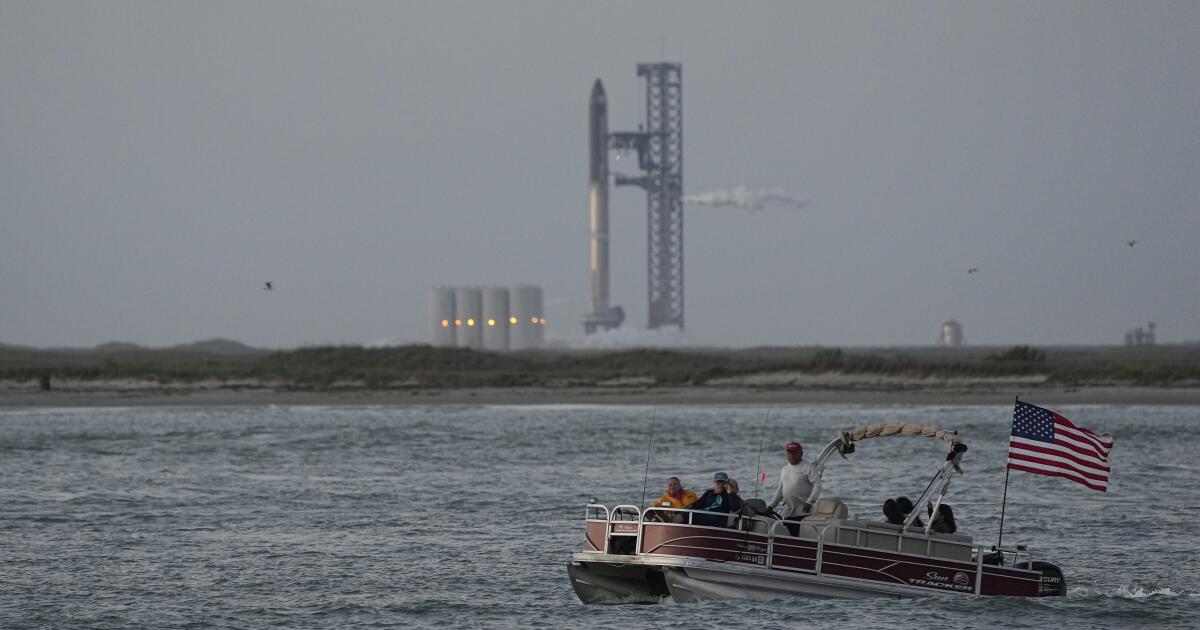
The third test flight of the SpaceX rocket that is intended to take humans back to the moon and someday to Mars blasted off successfully Thursday morning.
The Starship rocket lifted off from the company’s Boca Chica, Texas, launchpad at roughly 6:25 a.m. PDT, with all 33 of the Raptor rockets on the ship’s Super Heavy booster lighting without incident and propelling the Starship into space.
The company’s previous efforts ended in explosions not long after launch, but gave scientists at Elon Musk’s company valuable information about its rocket system, which is by far the most powerful spaceship ever built. SpaceX secured approval Wednesday to conduct the latest flight from the Federal Aviation Administration.
The flight exceeded in some ways the company’s main goals, which had been to travel longer than the prior flights and nearly reach orbit. Secondary objectives were to execute the opening and closing of Starship’s payload doors, using tons of reserve fuel in flight and stopping and restarting the rocket’s Raptor engines.
Starship is key to the company’s financial security. The spaceship and the Super Heavy booster it is attached to are intended to eventually replace the company’s workhorse Falcon 9 rocket. It is intended to not only carry cargo and crew to the lunar surface but launch more and larger Starlink broadband satellites than the company’s existing lineup of rockets can.
Like the Falcon rockets, the Starship and Super Heavy booster are both designed to return to Earth and be reusable, which Musk has said will dramatically lower the cost of space travel. On Thursday, an attempt to have the booster return to Earth in a controlled descent failed. .
Last April, the company launched the Starship rocket for the first time. The rocket cleared the launchpad, at the southern tip of Texas near the Mexican border, and soared above the Gulf of Mexico for a few minutes before exploding.
SpaceX later said that a propellant leak caused multiple engines to fail and the explosion was caused by the rocket’s autonomous flight termination system, which is designed to make the rocket self-destruct if the software senses that it is going off-course or that its performance is unsafe.
The launchpad also was damaged on blastoff — sending debris flying across nearly 400 acres.
SpaceX’s second test flight in November lasted about twice as long, giving the craft time for the booster and Starship to separate. The booster exploded moments after falling away, followed shortly by the Starship. That explosion, too, was due to the rocket’s autonomous flight termination system.
Starship, with its Super Heavy booster, is the largest and most powerful rocket ever developed, taller than the Saturn V that sent Neil Armstrong to the moon and with about twice the thrust. If the company completes its mission to the moon, Musk will be a small step closer to his goal of taking humans eventually to Mars. The company already has a contract with NASA to carry people to the moon.
The aerospace company, formally known as Space Exploration Technologies Corp., doesn’t typically view in-flight failures during a rocket’s development as major setbacks, but rather learning moments that help develop its vehicles further.
Regardless of the outcome of the latest mission, SpaceX still has a long way to go until people can take trips to Mars. Those items include figuring out life support systems and how to land the spacecraft in one piece.
Bloomberg News contributed to this report.